
Moisture control in cold storage and logistics – safety, energy savings, and a stable cold chain
We help you keep operations running around the clock, no matter what happens outside the doors.
We know your environment, and what moisture does to it
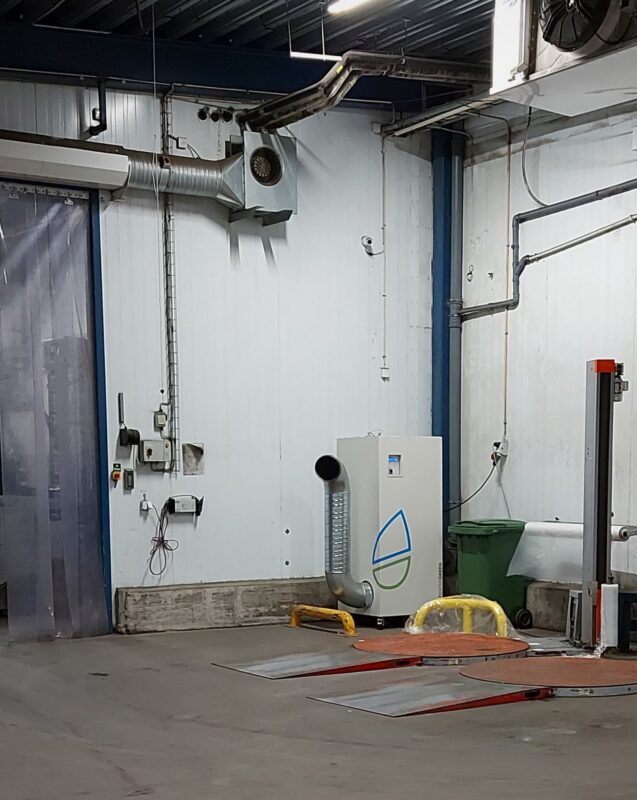
Cold storage facilities and logistics terminals operate under a constant moisture load. We have installed NEXT in cold storage and logistics terminals across several countries, and the challenges look similar everywhere.
- Warm and humid outdoor air penetrates through loading docks and door openings, condensing inside the cold facility.
- Condensation accumulates on ceilings, cold surfaces, rails, and goods, resulting in dripping water.
- Ice formation on the cooling units' evaporators increases the need for defrosting and drives up energy consumption.
- Wet floors create slip hazards for forklift drivers and staff – in worst-case scenarios, operations must be shut down as a safety precaution.
- Packaging and goods absorb moisture and risk being damaged along the entire cold chain.

Member of the Global Cold Chain Alliance
As a member of the GCCA, Airwatergreen is part of the international network for temperature-controlled storage, transportation, and logistics.
What NEXT does in cold storage and logistics
A safer working environment, around the clock
Wet floors in a logistics terminal pose a direct safety risk. Slippery surfaces lead to forklift accidents, and in severe cases, safety representatives shut down operations. With NEXT, moisture levels are kept stable and floors dry – allowing operations to run without interruption, even during summer when the moisture load is highest.
Lower energy costs without compromising cooling performance
Refrigeration units are dimensioned for cooling, not for managing moisture. When moisture levels are high, ice forms on the evaporators, defrost cycles increase, and energy consumption rises unnecessarily. NEXT removes moisture directly from the air, relieving the load on the refrigeration units. This is reflected in the energy bill.
Performs where other dehumidifiers fail
Condensation-based dehumidifiers lose efficiency as temperatures drop, often already below approximately +10 °C. NEXT is engineered for cold environments and maintains its high performance all the way down to 0 °C.
There is energy to be saved – how much depends on your facility
An example: A 4,000 m² cold storage facility saved 300,000 kWh per year after installing NEXT – compared to the previous solution. The energy consumption for dehumidification landed at 1.38 kWh per liter of removed water.
See what this would mean for your facility.
Settings
Estimated annual savings — NEXT compared to alternatives
Annual energy consumption — comparison (kWh)
Details
Reference — efficiency per temperature (kWh / kg extracted water)
| Temp. | NEXT | Desiccant | Condensation |
|---|
The calculation is based on NEXT 300 · 365 operating days per year. Capacity and efficiency data: Airwatergreen internal specifications. Energy prices are approximate guidelines for commercial/industrial consumption — enter your actual price above for an accurate result. The results are estimates intended for planning purposes. CO₂ savings: coming soon.


Discuss your facility with a specialist
Tell us about your environment. We will help you understand the problem and find the right solution.