
Indoor humidity rarely changes in a predictable manner. People come and go, doors open, production cycles begin, and weather conditions fluctuate. Despite all these variables, dehumidification has long been governed by a relatively simple principle: if the humidity exceeds a certain threshold, the unit operates until levels drop below the setpoint.
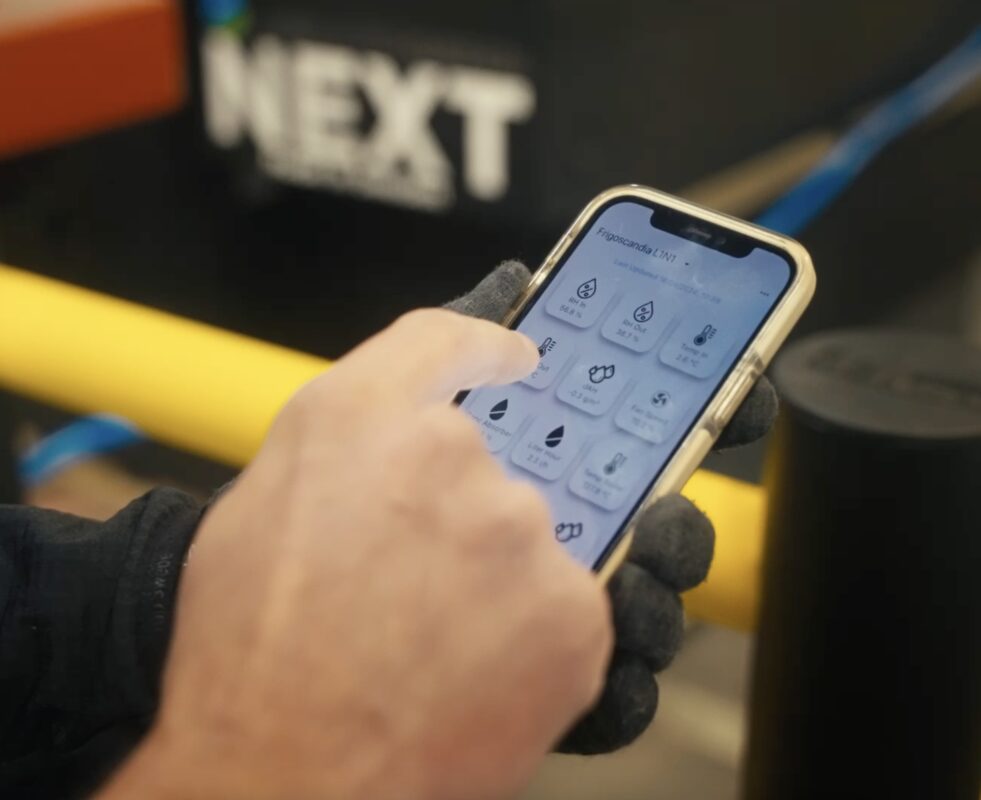
With NEXT, Airwatergreen wanted to go further. Sensors and connectivity are integrated into the system to monitor and adapt the dehumidifier's operation while providing a clearer understanding of how the indoor climate evolves. This information delivers a more transparent view of the actual dynamics within the environment where the unit operates.
Smart dehumidification is built on relevant data
Among other functions, NEXT modulates fan speed based on prevailing conditions. Measurement data is actively utilized to regulate the dehumidification process. Sensors can be positioned throughout the building, and the system can integrate with existing building automation systems. In the event of an unexpected humidity fluctuation, an alarm can be triggered to prompt investigation.
A high RH value does not tell the whole story. An anomaly may be temporary and caused by a specific activity. It might recur at the same time every day or deviate entirely from normal patterns. This type of data can be leveraged to better tailor dehumidification to the actual events occurring on-site.
A dehumidifier does not need to operate identically at all times
Different situations place varying demands on dehumidification. At times, humidity must be reduced rapidly. Conversely, specific activities—such as surface cleaning and washing—can generate sharp, short-term moisture peaks.
Consequently, NEXT features multiple operating modes. Auto Run serves as the default mode. Target Mode prioritizes rapidly reaching the desired relative humidity. Eco Mode adapts operation to the actual moisture load with the objective of minimizing energy consumption. Wash Handler is engineered for environments where recurring moisture peaks occur during limited periods.
For the user, this does not translate to an increased burden of daily decision-making. Rather, Smart dehumidification represents optimized control, allowing the unit to respond to actual demands instead of constantly operating based on the most demanding scenario.
Energy is not just about quantity, but also timing
How much energy a machine consumes is one aspect. When it consumes that energy is another.
NEXT can utilize electricity prices based on 15-minute intervals. In Tariff Mode, this data is used to optimize regeneration cycles. When process parameters permit, a larger share of regeneration can take place when electricity prices are lower, and be reduced when prices peak.
Maintaining the correct climate will always be the primary priority. However, shifting operational cycles in time unlocks additional opportunities to optimize energy costs.
From remote monitoring to streamlined troubleshooting
NEXT is built upon a control platform that enables remote monitoring and seamless integration with external systems and sensors.
For support and service teams, this same data proves invaluable during troubleshooting. If any parameter deviates from the norm, operational data can be reviewed remotely. This frequently provides an initial diagnosis of the issue before a technician even arrives on-site.
This is also where Erik Bjernulf identifies one of the principal advantages of aggregating data over time. By comparing current readings with historical data, trends and deviations become much easier to detect. This could involve moisture peaks recurring at specific intervals, shifting indoor conditions, or an operational pattern that suddenly diverges from standard baselines.
Ultimately, this information contributes to a comprehensive understanding of both dehumidifier performance and the operational environment.
Technology should assist, not complicate
For most users of a dehumidifier, the technology behind the system is rarely the primary concern. Maintaining a stable climate, detecting fluctuations, and avoiding excessive energy consumption are what truly matter.
This is precisely why these capabilities were engineered into NEXT from the outset. Sensors, control systems, connectivity, and the dehumidification process work in unison rather than functioning as retrofitted add-ons.
Requirements vary across facilities and industries, yet the need to comprehend actual operating conditions remains universal. For some, maintaining a stable climate is the highest priority. Others must manage recurring moisture peaks, while some seek enhanced control over their energy consumption.
Fundamentally, this is what smart dehumidification is about: utilizing accurate data to optimize machine operation according to the specific demands of the operating environment.