
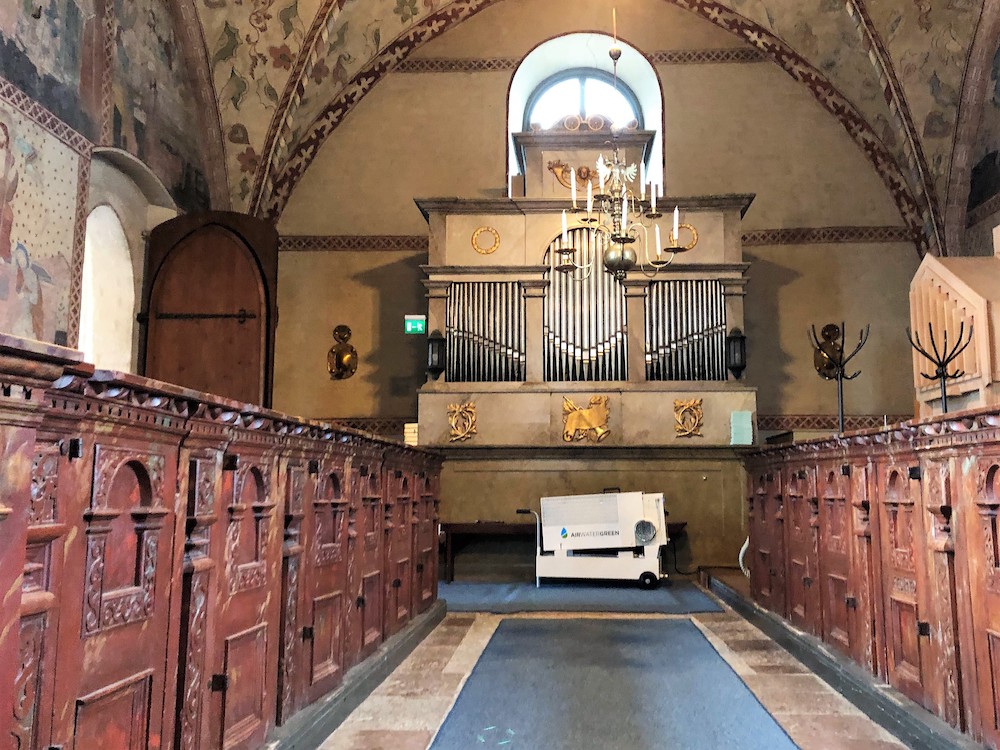
In our ancient churches, where history and spirituality meet, maintaining a good indoor climate is not only a matter of preservation but also of well-being for both visitors and staff. The Diocese of Lund has therefore developed detailed recommendations for determining the optimal relative humidity (RH) in the diocesan church buildings, a guide that aims to protect the churches' structure, fixtures and fittings.
Background to the recommendations
Understanding that each church building is unique, it emphasizes the need to create an indoor climate that takes into account the specific conditions of the building. The document available for download replaces the previous requirement for specialist advice on the installation of dehumidifiers and provides general yet tailored guidance.
Relative humidity is a key measure in the recommendations. RH indicates how much moisture the air contains in relation to the maximum amount of moisture the air can hold without condensing. Understanding and controlling this measure is crucial to avoid condensation and the problems that can arise from both too high and too low RH levels.
Challenges and Solutions
High or low RH levels can lead to a range of problems, from mold growth and organ damage to wood cracking. The document therefore emphasizes the importance of keeping RH levels within specific ranges to prevent these challenges. For church organs in particular, there are additional requirements for humidity and temperature uniformity to maintain the quality and function of the instruments.
Mold and its prevention
Mold is a common challenge in church buildings, and recommendations point to the importance of keeping RH below 70-75% to prevent mold growth. This is particularly important as mold growth can not only damage the building and its furnishings but also pose health risks.
Salts and lime paintings
Another important aspect addressed in the document is the management of salts in masonry. The salts, which can cause damage to plaster and paintings by dissolving and then crystallizing at different RH levels, need to be managed by keeping a relatively constant RH level.
Conclusions and Recommendations
Ultimately, the aim of the recommendations is to provide guidance that will enable the best possible protection and conservation of Lund Diocese church buildings. By following these guidelines, it can be ensured that church spaces maintain an RH level of 56-68%, which is optimal to prevent the most common problems related to indoor climate.
More than 250 churches are equipped with an Airwatergreen solution.